
Torah, Halakhah, and Divine Presence in Mark 1.1-8
All readers, please read this preface, even if not reading the entire post!
Each weekly post connects the first century Jesus Movement to Judaism. I like to state at the outset, especially for new readers, that this is not an effort to endorse a version of messianic Judaism. Rather, the effort is to contextualize Jesus, a first century Jewish man, and the movement he started, within its proper historical, cultural, and cultic setting. These posts are intended to be celebrations of Judaism and educational for readers.
I want to extend an invitation to please complete the poll and/or comment at the end of this post!!
We are nearing a year of publication, and writing these posts is not without its effort of time, research, and energy. If I’m candid, the growth has plateaued. We haven’t added a new subscriber in a few weeks, and only three people signed up for the book study (you’ll receive a separate note). I love this work. I can’t see myself not engaging this material in some way, but behind each post is at least 10 hours of work—I’m always reading, so it’s hard to precisely quantity. Things that I’m considering:
Maintaining as is, but moving to a mostly paid model, $6-$8/month? Thank you to existing paid subscribers!
Keeping mostly free, but shifting to video content only where I can be less rehearsed and more off-the-cuff to save the writing time
Extending the length of time between posts to maybe one or two each month
Discontinuing the newsletter. This is totally OK! I don’t see this as failure! This has been an experiment, and it’s fine to say, “You know what, that didn’t work out”
Please take a couple minutes to complete the poll questions at the end of this post. Even if you don’t read today’s post, it would really mean a lot to me if you scroll down and complete the poll. Cheers! -jPK
The Joy of Torah
Simchat Torah, or the “Joy of Torah,” is an annual celebration in the Jewish liturgical calendar that recognizes the end or our annual reading of Torah, divided by portions, or a parsha, that anchors the rhythm of the Jewish year, along with the festivals. Each week a parsha is assigned to be read from the bimah in the synagogues, like an altar, but not the altar that was the ceremonial locus of cultic practice when the Temple stood. When following the weekly portions, the entire Torah is read each year.
Modern rabbis offer a d’var Torah, or word of Torah, like a sermon, about the weekly Torah portion; b’nei mitzvah students (usually children of 12 or 13 years of age; b’nei is simply the plural form of the singular bar or bat mitzvah), are often instructed to read the parsha from the bimah on shabbat to fulfill a requirement in their coming of age ceremony that marks the time when youth become adults and decide their commitment to Judaism.
In home practice, religious Jews, and maybe many secular Jews, a category in which I may fall, treat the weekly Torah portion as a sort of devotional practice. To this end, several Torah guides are available. Several Jewish publishing houses have Torah commentaries that include reflection on the parsha, including my go-to Jewish Study Bible, from the Jewish Publication Society. On my bookshelf is a bedtime Torah commentary, a women’s Torah commentary that reflects on Torah through a feminist lens, and a social justice Torah commentary that comments on the parsha through modern social justice concerns.
The Torah was read in synagogues, even in the first century. In fact, the Lukan author, describes Jesus reading from a scroll in the synagogue–though the scroll named is Isaiah, a prophetic text, and not from Torah, I think we read Luke’s author here making a theological point, not a practical one, and I don’t take the prophetic text to undermine the claim that the Torah was read weekly. This is how a mostly illiterate first century Jewish audience would learn about what Gd asks of them:
When he came to Nazareth, where he had been brought up, he went to the synagogue on the Sabbath day, as was his custom. He stood up to read, and the scroll of the prophet Isaiah was given to him.
Simchat Torah, the joy of Torah, indeed has its roots in the Second Temple period, occurring immediately following Sukkot, a pilgrimage festival, when many Jews may still be in Jerusalem. Importantly to the discussion in today’s post, as we will see, the first century rabbis held that wherever the Torah is read, there is the Divine presence, or shechinah. Christians, where have you heard it said that where people gather in my name, I am with them?
In modern practice, Simchat Torah is a joyous celebration of singing, dancing, feasting, and drinking! I’ve attended several Simchat Torah celebrations at Temple, and while we sing and dance the rabbis or other leaders parade the Torah scrolls around the sanctuary, while worshippers kiss their prayer books, then touch it to the Torah scrolls–the Torah scrolls are so sacred that they are not to be touched with our hands, so we kiss our prayer books, then press it to the scroll as the rabbi comes bouncing by with the the scroll. In fact, this meaning-making practice is with me all year long. You may be interested to know that when preparing these posts and reading from the sacred texts on my bookshelves, I kiss the texts when closing them and returning them to the bookshelf. I arrange my Torah and Bibles at least one shelf up from the bottom bookshelf to be sure they don’t touch the ground. These are the practices that I think sustain us, even though I don’t fear any Divine retribution for failing to do so. These rituals ground the values of my life.
My eyes are wet with both joy and sorrow while thinking of this celebration. The joy is obvious, why the sorrow? Because it was following Simchat Torah that the terrorist attacks of October 7th occurred in Israel. Strategically, Hamas would know that many people would have been up late partying for Simchat Torah and not at their sharpest to evade or repel the attack. The security failures of the Netanyahu administration should not be overlooked, but this is also part of the context.
So what does all this have to do with this week’s assigned lectionary reading from the gospel?
The Text
Mark 1.1-8 begins, “The beginning of the good news of Jesus Christ.”
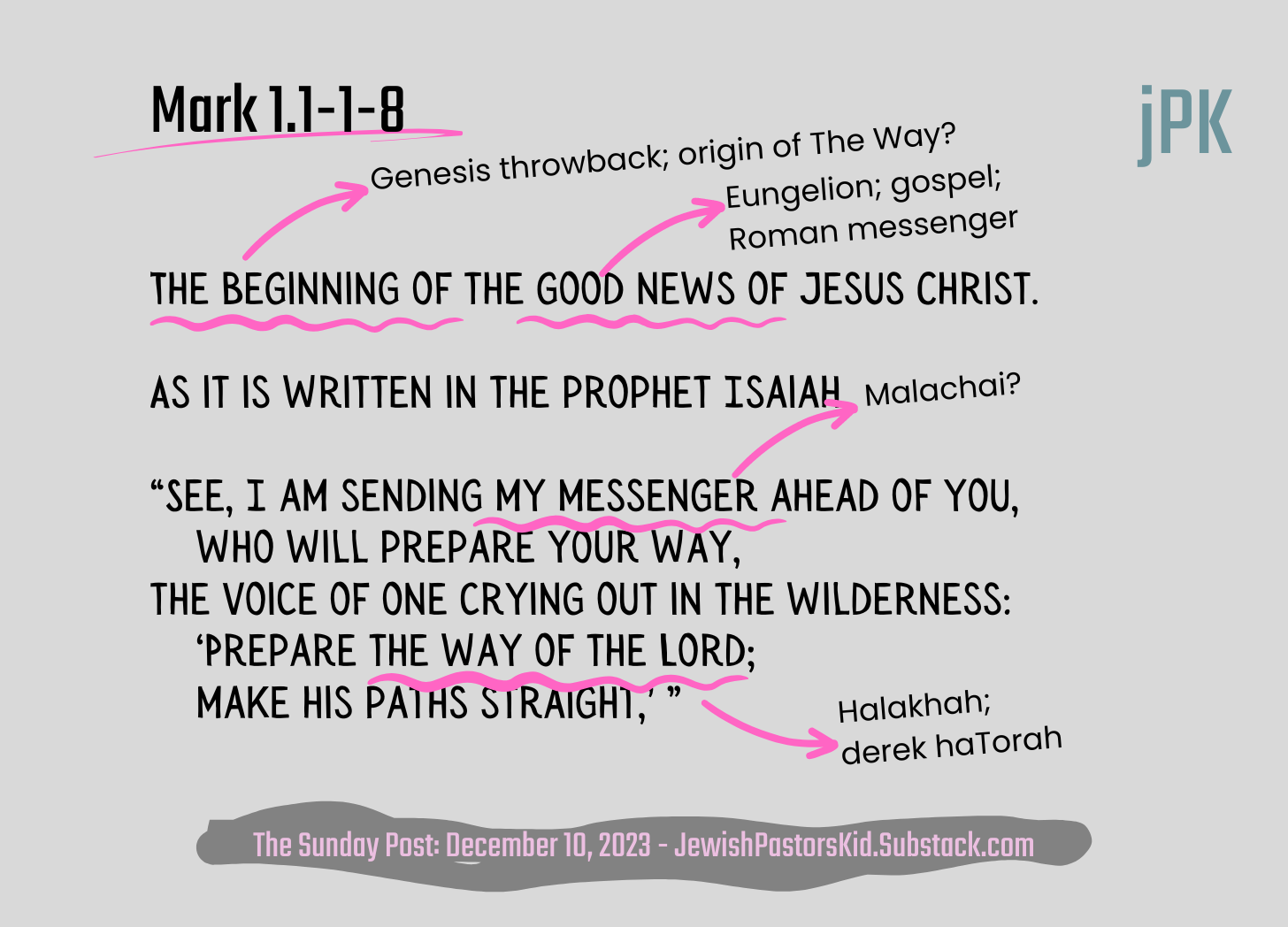
Does this remind you of something? Pat yourself on the back if you recognized another beginning from the Bible: “When God began to create the heavens and the earth.”
In fact, I argued recently that Mark’s beginning, or should we say, Genesis, informs readers (hearers) immediately that what they are encountering is a theological proclamation that offers an origin for the people–the Jesus people. The origin, or genesis, of The Way, a name that early Christians may have called themselves, likely an application of Isaiah 40.3:
A voice cries out:
In the wilderness prepare the way of the Lord;
make straight in the desert a highway for our God.
Oh, I mean, Mark 1.2-3:
As it is written in the prophet Isaiah,
“See, I am sending my messenger ahead of you,
who will prepare your way,
the voice of one crying out in the wilderness:
‘Prepare the way of the Lord;
make his paths straight’”
In fact, the idea of a Way is connected with the way of Torah, derekh haTorah, the way of Torah, or in Talmudic terms, halakhah, the way of Jewish law, which began in the first and second centuries. This is a more speculative point, but do we have reason to think these ideas of The Way from the Jesus Movement and later gospel development considered their own intrepretive tradition around the Torah–the written law. We’ve previously discussed that Jesus’ disagreement with Pharisees is often owing to disagreements about the written and oral law traditions, with the gospels lifting up a written law tradition.
In addition to the connection with Torah (Genesis) and the prophetic tradition (Isaiah), with respect to an origin, we also have a herald of good news. This good news, or euangelion, or gospel, we also have a connection to explore, consider, again, Isaiah:
Get you up to a high mountain,
O Zion, herald of good news;
lift up your voice with strength,
O Jerusalem, herald of good news;
lift it up, do not fear;
say to the cities of Judah,
“Here is your God!”
And here, too:
How beautiful upon the mountains
are the feet of the messenger who announces peace,
who brings good news,
who announces salvation,
who says to Zion, “Your God reigns.”
See, the good news, or euangelion, was not an early Jesus Movement invention; rather, the gospel authors were further tapping into the prophetic tradition, where the prophets heralded a message of good news. And, get this, in the Roman world, good news was also a common expression! Check this out!
The classical Greek word euangelion means “a reward for bringing of good news” or the “good news” itself. In the emperor cult particularly, in which the Roman emperor was venerated as the spirit and protector of the empire, the term took on a religious meaning: the announcement of the appearance or accession to the throne of the ruler.
We cannot overlook the subversive political move! Mark’s author is repurposing a Roman message to honor Caesar and applying it to Jesus, who Mark’s author proclaimed as the Christos. To those who imagine that Jesus isn’t political, as I’ve heard in many Christian communities, the gospels authors themselves were making international use of honorifics reserved for Roman rulers and applying them to their mashiac, their deliverer. Who was their deliverer delivering them from? Roman occupation.
I’ll note two further connections that would ostensibly be familiar to a first century Jewish audience, the first, as a messenger to prepare the way. We’ve discussed this at length in previous posts that the gospel authors characterize John the Baptist as Elijah, the forerunner to the messiah, in Jewish apocalyptic theology. Here, from the prophetic text, Malachi, a name that itself means messenger!
See, I am sending my messenger to prepare the way before me, and the Lord whom you seek will suddenly come to his temple. The messenger of the covenant in whom you delight—indeed, he is coming, says the Lord of hosts.
Interestingly enough, Malachi favored Torah over prophecy. Given our discussion of The Way and Torah observance, we wonder if Mark selected Malachi here in particular to favor the interpretive tradition of written law observance. It’s been suggested that Ezra, a late-post-exilic text (and priest) who led the post-exilic return to Jerusalem may be author of Maliachi, and we know that Ezrah likely compiled the version of Torah that would become authoritative in the Second Temple period. Is the Markan author weaving these interpretive traditions together?
Still, prophecy clearly features significantly, as we’ve seen. John the Baptist himself is described as a wilderness figure that not only sees the gospel authors casting him as Elijah, the forerunner to the messiah, the narrative relationship between Elijah and Jesus may also bring to mind other famous duos from the Scriptures of Israel, like Moses and Aaron, Elijah and Elisha, and now, John and Jesus.
John, for his part, baptizing people in the river Jordan is consistent with both the tradition of the Essenes, that we’ve associated with John, this discussion also reminds scholars of a first century ahistorical text, Judith, who is also described as bathing in a river:
So Holofernes commanded his guards not to hinder her. She remained in the camp three days. She went out each night to the valley of Bethulia and bathed at the spring in the camp. After bathing, she prayed the Lord God of Israel to direct her way for the triumph of his people. Then she returned purified and stayed in the tent until she ate her food toward evening.
While I’m averse to the military undertones of the passage, this example further emphasizes the importance of ritual bathing to the first century Jewish community.
In the Beginning (of the End of this Post)
Let’s put this all together to see how the Markan author is describing the origin of The Way. The author begins with an interpretation of Genesis, quickly pivots to a herald of good news that would remind listeners of both the prophetic tradition of Gd’s deliverance through a prophetic tradition and Rome’s usual announcement for an emperor rising to power.
Reader Poll
Please share any comments below to inform the future direction of this newsletter. Comments are open to everyone!

 Hitzonim | Outsiders
Leave a comment