
The Significance of Deuteronomy for the Matthean Author; Location and Events
After a few one-off posts, we’re back to our regularly planned schedule around here. The effort, recall, is restoring the authentic Jewish voice to the gospel accounts (if you need the intro, here’s a reminder about the project). The primary way that I approach this task is by appeal to the Revised Common Lectionary and the weekly assigned gospel reading.
Introduction: Matthew, Deuteronomy, Jeremiah, and Corporate Repentance
This week we take a look at Matthew’s gospel and the instruction placed in the mouth of Jesus to the disciples to find the “lost sheep of the House of Israel.” In today’s post I’ll present evidence that Matthew’s author leveraged Deuteronomy as a central text for their characterization of Jesus and Jesus’s ministry, namely that Jesus is portrayed as a new Moses calling for obedience to God and ritual observance for the people of Israel, and we’ll wonder whether the setting for the Matthean author supports the theological thrust of the gospel.
The main idea is that Matthew’s gospel leverages the Deuteronomistic program of sin-repentance, where each element is to be understood corporately, not personally.
That’s a lot to do with limited space, and so, I’ll gesture toward many citations, acknowledging along the way that this is a lay-directed newsletter for a general audience and not an academic thesis! My insights here are not entirely novel, but I hope to make a strong case that the argument I piece together is a sound one. The conclusion that I hope we reach together is to better understand what the late-first century author had in mind for their gospel and what behavior among readers this gospel was intended to reinforce. The main idea is that Matthew’s gospel leverages the Deuteronomistic program of sin-repentance, where each element is to be understood corporately, not personally. The Matthean text proceeds stepwise to first commission the disciples to the lost sheep of the House of Israel, then, in the post-resurrection setting, to commission the disciples to all the nations.
The Text
As the schedule for both the Lectionary and this newsletter would have it, we’ve already looked at this commissioning, in relief to the so-called Great Commission that I wrote about a couple weeks ago. Feel free to catch up on that post.
In that post from June 4, 2023, we connected Jesus to Moses. What interpretive work might we do with this week’s reading? Let’s first get to the text.
Matthew 9:35-10:8
New Revised Standard Version Updated Edition
35 Then Jesus went about all the cities and villages, teaching in their synagogues and proclaiming the good news of the kingdom and curing every disease and every sickness. 36 When he saw the crowds, he had compassion for them because they were harassed and helpless, like sheep without a shepherd. 37 Then he said to his disciples, “The harvest is plentiful, but the laborers are few; 38 therefore ask the Lord of the harvest to send out laborers into his harvest.”
10 Then Jesus summoned his twelve disciples and gave them authority over unclean spirits, to cast them out, and to cure every disease and every sickness. 2 These are the names of the twelve apostles: first, Simon, also known as Peter, and his brother Andrew; James son of Zebedee and his brother John; 3 Philip and Bartholomew; Thomas and Matthew the tax collector; James son of Alphaeus and Thaddaeus; 4 Simon the Cananaean and Judas Iscariot, the one who betrayed him.
5 These twelve Jesus sent out with the following instructions: “Do not take a road leading to gentiles, and do not enter a Samaritan town, 6 but go rather to the lost sheep of the house of Israel. 7 As you go, proclaim the good news, ‘The kingdom of heaven has come near.’ 8 Cure the sick; raise the dead; cleanse those with a skin disease; cast out demons. You received without payment; give without payment.
A Commission to Israel
The first move I’d like to make here is to to better understand what the gospel writer has Jesus commissioning his disciples to do. “Proclaim the good news” reveals itself in the text above, but just what is this good news? To be sure we characterize this in a Matthean way, let’s rewind a bit and take a look earlier in Matthew.
In the Matthean birth narrative, the author is doing some heavy lifting to attach Jesus both to the stories about Moses and to the prophetic tradition. I want to point out a quote from Jeremiah appearing in Matthew 2:18. There, we get an early sense of what the Matthean author is up to (Crowe, B. D. (2012). The obedient son: Deuteronomy and Christology in the gospel of Matthew (Vol. 188). Walter de Gruyter):
Likewise, [Jeremiah] 31.15 (cited in Matt 2.18) is found wedged between two texts that speak of Israel’s failures as God’s son and their hopes for future restoration as God’s beloved son (Jer 31.9, 20). Thus one could argue that Matthew has a penchant for citing OT passages in which Israel is referred to as son of God.
From the same book, Crowe continues:
Jesus as Son of God (for Matthew) must to some degree be bound up with Jesus as Israel; and since Israel’s sonship is to be defined by obedience in Deuteronomy and related literature; and since Deuteronomy is clearly a key text for Matthew; therefore, it is quite likely that Matthew derived his understanding of and need for obedient sonship (both for Jesus and his disciples) in large measure from Deuteronomy.
Let’s pause to process that suggestion from Crowe. His argument is that Jesus is not the first to carry the title, son of God, but that within the Scriptures of Israel, Israel itself is also referred to as Son of God—a beloved son, even. This is important!
Crowe concludes this discussion, finding that:
[T]he first mention of Israel as [God’s]* children is found ([Jeremiah] 3.14). Echoing the theme of Israel’s filial faithlessness from Deut 32.5–6, 20, in [Jeremiah] 3.14, [God]* identifies Israel as his faithless sons—referring to either Judah alone or to both Israel and Judah—and calls them to repent.
The Matthean author is getting us onto an idea as early as Jesus’s birth narrative that, from the prophetic tradition, we are to understand that God has already recognized the people of Israel as God’s son, and when unhappy with them, when Israel is “faithless,” God has called for their repentance.
As we move forward from birth narrative to baptism, we continue to apply what we’re learning. John the baptizer proclaims repentance, just like Jeremiah! For the kingdom is at hand! Then the holy spirit descends on Jesus during baptism to affirm that this is my son the beloved. If Israel is God’s beloved son; if the prophets call Israel to repent; if John calls Israel to repent; if Jesus is a stand-in for all of Israel; if Jesus is God’s son, like Israel, then both the call for repentance and the affirmation of belovedness is not about Jesus alone, but about the symbolic nature of Israel as God’s son and Jesus as its deliverer. This is affirmed in an act of Jesus’s corporate baptism. Corporate, as in, all of Israel—that which Jesus represents.
John the Baptizer, at least for Matthew, is calling for God’s beloved children to repent, even before Jesus vocalizes this commission to the disciples. What, then, does Jesus commission the disciples to do? To go to the lost sheep of the House of Israel and tell them the kingdom is at hand! Moving from birth, to baptism, to ministry, following the the sin-repentance model of Deuteronomy and the prophetic tradition, I submit that the Matthean author is expertly stitching together a technical analysis of the Deuteronomistic Historian and placing Jesus in this tradition.
To support this point, and I credit the JANT with this insight, consider how 1 Kings 22:17, a book within the Deuteronomistic History, describes Israel:
Then Micaiah said, “I saw all Israel scattered on the mountains like sheep that have no shepherd, and the Lord said, ‘These have no master; let each one go home in peace.’”
To lean further into the Deuteronomistic literature, by Jewish tradition, Jeremiah is often mentioned as a “prophet like Moses”—the case we’ve been making about Matthew’s effort with Jesus. Jeremiah is even said to be the author of Kings that we just quoted! With that in mind, consider this from Jeremiah 16:16, God calling followers:
I am now sending for many fishermen, says the Lord, and they shall catch them, and afterward I will send for many hunters, and they shall hunt them from every mountain and every hill and out of the clefts of the rocks.
Where else have we read about fishermen being called? Matthew 4:18-19:
As he walked by the Sea of Galilee, he saw two brothers, Simon, who is called Peter, and Andrew his brother, casting a net into the sea—for they were fishers. And he said to them, “Follow me, and I will make you fishers of people.”
The point I have been hoping to make here is that the Matthean author is leveraging well-known (to his audience, at least) scriptural references to assert that Israel is God’s son, and we’ve been faithless, like lost sheep without a shepherd. And like Deuteronomy tells us, when we stray, we must be called to repent, to turn toward God, and now the end time is here, proclaims John the Baptist, and we have a deliverer, Jesus, to reach the lost sheep of the House of Israel to return us to God.
Jesus, the symbolic Israel, who is God’s beloved son, who escaped the death of Herod (Pharaoh and the killing of the first born) and was tested in the wilderness (Moses in the Exodus), is here with the authority of the Law (Deuteronomy calling for repentance) and the Prophets (Jeremiah affirming Israel is God’s beloved) to reach the lost sheep of Israel (1 Kings from the Deuteronomistic History and scattered sheep wtih no shepherd) to turn corporate Israel toward God because the kingdom is at hand!
Because I’ve positioned Jesus as the deliverer of God’s beloved children, Israel, I do so to summarize what I think the Matthean author is up to, but I am not, myself, endorsing that view!
I’ll pause briefly to caution against Christian supersessionist thinking. I hope to have presented a strong argument here that Matthew is making a case for Jesus in the way I’ve described. But it must be noted that for many (not all) first century Jews (that’s an anachronistic term, as I’ve described, but it serves our purposes) and certainly for Jews today, Jesus is not viewed as the anointed one, the one specially commissioned by God, the messiah, or mashiach. Because in this post, by dint of the Matthean author, I’ve positioned Jesus as the deliverer of God’s beloved children, Israel, I do so to summarize what I think the Matthean author is up to, but I am not, myself, endorsing that view! I am only arguing that I think this position is akin to what the Matthean author had in mind!
I hope to address Christian readers of my newsletter to deepen their understanding of the first century Jesus movement in its Jewish context, and in so doing, nothing would make me happier than enriching your confessional stance! Though, by analyzing what the author of Matthew’s gospel is doing, I am not suggesting that position be adopted.
Further, my position that I’ve clearly articulated in other posts, is that the first century gospel writers looked backwards to their tradition—the Scriptures of Israel—to bring forward evidence to support their claims about Jesus. It is certainly not my position that where we see excerpts from Deuteronomy or Jeremiah or anywhere else that those were prophesying toward Jesus. Moreover, the sin-repentance model in the Scriptures of Israel is about the repentance of the people, not a single person. When Jesus calls for repentance, as often cited by Christians, the call is not for individual repentance of sins, but about the people Israel turning toward God.
The idea of personal sin, personal confession, personal salvation is within Christian doctrine. True that between Rosh Hashanah and Yom Kippur, Jewish people are engaged in a confessional period of teshuvah, or repentance, but Christians should be careful not to mistake the Jewish Jesus of the first century calling for repentance of sin in the way that a pulpit preacher may be doing today. Israel is am Yisrael, the people of Israel.
At any rate, however we understand Jesus in light of commission and covenant making, the notion of messiah and covenant as understood in Christian communities would not exist were it not for the Scriptures of Israel. The people of Israel are chronologically, logically, and theologically prior to Christianity. There is no replacing the covenant with Israel, and Jews need not view Jesus as messiah.
Transjordanian Geography
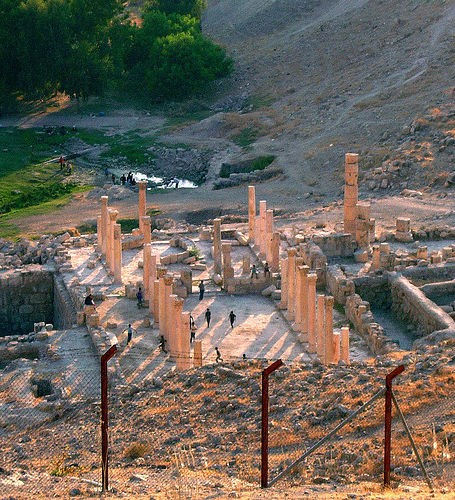
Before concluding, I’d like to briefly address the setting of composition for Matthew. I think the conflict between sectarian groups reminds us that each gospel is written with its own rhetorical goals in mind. Pella, in the Transjordan geographical area, is suggested (Slingerland, H. D. (1979). The Trans jordanian Origin of St. Matthew’s Gospel. Journal for the Study of the New Testament, 2(3), 18-28):
Thus, in Matt 4:15 and 19:1 we have direct internal evidence for the general place of authorship of the first gospel. … Pella in the Decapolis suggests itself. This city was, presumably, an important Christian center. … Again, Pella would eventually need its own gospel, and a date of ca. 90 C.E. for the writing of Matthew might correspond to the height of first century Christian activity in that city.
I think this remark about the community needing its own gospel is an insightful one. After the destruction of he Temple, communities splintered. Paul, sometimes at odds with the Jerusalem community, journeyed to bring his good news to gentiles—in fact, the earliest Pauline writing predates the earliest gospel (Mark) by twenty years! But Paul’s theology differed greatly from the Mosaic law, in so far as what he asked of his gentile communities. In addition to the Matthean community we’ve examined today, the Johannine community produced its own gospel with its own distinct message.
Matthew is certainly post-Temple and composed outside of Jerusalem, by the gospel writer’s own reporting. Is there reason to find the author’s report factual? We have further evidence maybe not for the location but for the motivation (Van Aarde, A. (2007). Jesus’ mission to all of Israel emplotted in Matthew’s story. Neotestamentica, 41(2), 416-436):
I read the Gospel of Matthew as a product of scribal activity within the context of the revitalization of villages after the destruction of the temple in Jerusalem. … Conflict existed between two sets of scribes: the Jesus followers, who acknowledged him as messiah and other Israelites who upheld the traditional view of the messiah. The conflict centered on the interpretation of the Torah: Jesus as the “second Moses” who fulfilled the Torah or the traditional Mosaic view as it was regulated by the temple cult.
And this slightly more recent paper also speaks in favor of communities fleeing Jerusalem after Temple destruction (Bourgel, J. (2010). The Jewish-Christian’s Move From Jerusalem As A Pragmatic Choice. In Studies in Rabbinic Judaism and Early Christianity (pp. 107-138). Brill):
If we admit that the Jewish Christians left the Holy City in the course of the Great Revolt [another name for the Jewish War, the conflict with Rome that led to Temple destruction], it is possible to infer that the Jewish-Christian communities, who carried on living in a Jewish environment following the War, did not wish to emphasize the light of the “Mother Church” from Jerusalem, but this inference must be qualified for many other Jews escaped from Jerusalem during the Great Revolt.
Conclusion
The Matthean author, somewhere north of Jerusalem, maybe in Pella, reworked portions of Mark to emphasize Jesus as a new Moses in the Deuteronomistic tradition. During this time of post-Temple Judaism, conflicts between competing Jewish sects produced their own literature and cultic practices. To gloss discussions we’ve had elsewhere, the Johannine community resisted the Pharisaic tradition and emphasized the high christology of Jesus. The Lukan account saw Jesus as a new Adam bringing a new Creation. Paul wrote to his gatherings with urgency and a de-emphasizing, if not outright rejection, of the Mosaic law.
Matthew’s author wrote within a busy trade city within a Hellenistic culture, on the Eastern boundaries of the Roman empire, 2,000 years ago. If you hear somebody judging you or others to repent for your sins, like Jesus said, remind them when those words were written, and crucially, why! Everything needs its context.
Adam out. ✌🏽
Note
*Note: I have replaced the tetragrammaton (the four letter Hebrew name of God), with simply “God” to avoid writing neither the tetragrammaton nor the transliteration of God’s name that is deemed to be blasphemous for members of the Jewish community to speak. Out of respect, I’ve followed that tradition here.
 Hitzonim | Outsiders
Leave a comment